A new book by Zac Bissonnette goes into the Beanie Baby Bubble uses that manic time to delve into the why of collective mania. Today, with bubble mania alive and well around every corner, we now have skinny jeaned pencil necks creating fart eraser apps market valued at $50 billion. Does this make sense any more than losing one's mind over dumb stuffed animals?
Think about another bubble burst phenomenon:
...the power of the revolutionary new technology,
assisted by artful manipulation of public perception by interested parties, induced
a collective hallucination that made investors ignore such considerations.
They persisted in ignoring them for several years, until ... the inevitable disaster struck. [emphasis mine]
Sound familiar? It should. But this isn't the dot com fiasco, nor the runup to EM08. It isn't this century, nor even the last. Citation's here.
A running point I have with my friend, TB, is given all of the psychopathic activity in finance, for instance hedge fund managers that get an edge via inside info, that casinos and card rooms by comparison are beacons of fairness and honesty. Someone who sits at a poker table in Vegas can be very sure that the game is a fair one, because it's not only highly regulated, but policed and prosecuted. Not the owners of this world. Evidently they can stomp around at will, free to create mayhem without fear.
Fear. It's an important aspect of EM08. The trillions hoovered up in the EM08 tsunami have created a vast divide in America, one that I find it hard to believe we'll ever recover from. I'm no math wiz, but the numbers on every front are terrifying. On the street, it's created a culture of fear among the working class, specifically about the present and down the line for their kids and country. Back on top, the evil empire dines on toro for a snack, and there's an utter lack of fear.
I've said before that I believe EM08 is three phases: The run-up and crash of '08, and the second phase, maximum extraction, which we are now in. That means power is doing everything it can to grow bigger and badder, and the evidence is overflowing.
Digression: Check out the Dan Dimicco interview from yesterday. I find his straightforward take not only refreshing, but pragmatic and on point. This country is at a crossroads, and the way we turn in the next few years are crucial. Dimicco reminds me of my mother's generation; no horseshitting around, let's get to work and produce. Let's unleash positive energy in the form of creativity and innovation bolstered by hard work. In a word, let's get our entrepreneur on.
Instead, the bureaucrooks went all in with a bunch of psychopathic criminals, the true super-predators, and we have what we have. It's sad.
And what of EM08's third phase? I used to say it'll be "Judgement Day" or some other dramatic sounding turn, but of late I've begun thinking that maybe phase two and three are a synthesis. In other words, maybe we're already in the crash. It's the feel good crash, buoyed by the collective, proven American ability to believe that somehow, someway, we're, *I*, am going to make it. As I've noted before, some historians believe the second most influential Nazi was Goebbels, which is a way of taking us back to the top: "assisted by artful manipulation of public perception by interested parties." To not know the tools of the devil is to be subject to them. Ask Eddie Bernays, behind the curtain.
Which reminds me of the saying, the most enslaved is the slave that believes he is not enslaved. Or is unaware of or willfully ignores it.
Plush Life Why did people lose their minds over Beanie Babies?
Mark Joseph Stern is a writer for Slate. He covers science, the law, and LGBTQ issues
A
5-year-old boy holds an armful of Beanie Babies while shopping with his
mother at the Zany Brainy Toy Store on Sept. 2, 1999, in Brentwood,
Missouri.
Photo By Bill Greenblatt/Getty Images
In July of 1999, I traveled with my
family to Tenby, Wales. The town is said to be picturesque, but I have
no memory of its scenery—except for a small toy store we passed on our
drive in. As soon as we settled into our hotel, my sister and I begged
our father to trek to the shop and search for the Britannia Beanie Baby,
sold exclusively in the United Kingdom. The Britannia bear wasn’t just a
toy, we explained; it was an investment, projected to be worth
thousands of dollars within a decade. Our father capitulated and bought
us each a Britannia bear, which we dutifully kept in mint condition
with the tag intact, reveling in its rarity while dreaming of the day it
would be a hugely valuable collector’s item.
One month later, the company that developed Beanie Babies abruptly
announced that it would stop producing the toys at the end of the year,
both anticipating and precipitating the burst of the Beanie Babies
bubble. Sellers panicked, buyers lost interest, and by the start of the
new millennium, Beanie Babies had swung from an economic and cultural
phenomenon to a tired punch line. Today, the Britannia Beanie Baby sells
for $10 on eBay. My own Britannia lies buried in a box in the back of
my closet along with hundreds of other Beanie Babies, where it has sat,
untouched, for 15 years.
From this distance, it’s easy to laugh at Beanie Baby fever, to mock
it as just another pointless fad in a chintzy, hollow decade. But in the
latter part of the 1990s, Beanie Babies were so much more than a fad:
They were a mania, an obsession that ensnared not just gullible children
but also otherwise responsible adults who lost all sense of perspective
over these plush playthings. People sold—and bought—some rare Beanie
Babies for $5,000 each and expected others to skyrocket in value
within a decade. (Collectors were careful to keep each toy’s tag
attached and protected by a plastic case; a Beanie Baby’s worth was said
to fall by 50 percent once the tag was removed.) Looking back, it’s
clear that the Beanie Baby craze was an economic bubble, fueled by
frenzied speculation and blatantly baseless optimism. Bubbles are quite
common, but bubbles over toys are not. Why did America lose its mind
over stuffed animals?
Zac Bissonnette’s new book The Great Beanie Baby Bubbledoes
an excellent job explaining the basic economic factors behind Beanie
Babies’ success. Ty Warner, the mastermind behind the toys, had a
remarkable talent for manipulating supply and demand. (He’s also a
borderline recluse and a profoundly troubled man; among other things,
Warner repeatedly dated the same women as his father—at the same
time—and became a plastic surgery addict.) First, Warner understuffed
his toys so that they were flexible and “looked real,” in his words.
Second, he sold only small batches of each new Beanie Baby to
independent businesses, refusing to supply large quantities to big-box
retailers and fixing the price of each toy at $5. Third, Warner
“retired” every animal after a fairly short amount of time, introducing a
new toy in its stead. This strategy created a near-hysteria each time a
Beanie Baby was released, sending fans rushing out to local stores to
buy the new toy before supplies disappeared forever.
All of this explains, in simple market terms, how Warner manipulated
supply and demand to build a frenzy for his product. But Bissonnette’s
book is disappointingly short on psychological explanations for why
Americans were eager to shell out at least hundreds of millions of
dollars for rather conventional toys. (The total spent on Beanie Babies
is unclear because ever-secretive Warner refused to release his
company’s earnings.) In one sardonic passage, Bissonnette cites Sigmund
Freud’s belief that “the root of collecting” lies in “sex and toilet
training,” as “the collector … directs his surplus libido into an
inanimate object: a love of things.” Bissonnette also hypothesizes that
collecting Beanie Babies “reflect[s] a regression to the soothing and
comfort provided by objects during childhood,” and that the acquisition
of a scarce, valued item activates our endorphins.
While Freudian theory hasn’t held up well to scientific analysis,
some sort of mental disturbance might account for the more extreme cases
of Beanie Baby addiction—like the retired soap opera star who lost his
children’s six-figure college fund investing in the toys, or the man who
committed murder over what a detective described as a “Beanie Baby deal
gone bad.” But does it really explain what sent millions of
Americans—soccer moms and CEOs, blue-collar workers and yuppies, Ph.D.s
and high-school dropouts—utterly bonkers over a brand of plush stuffed
animals?
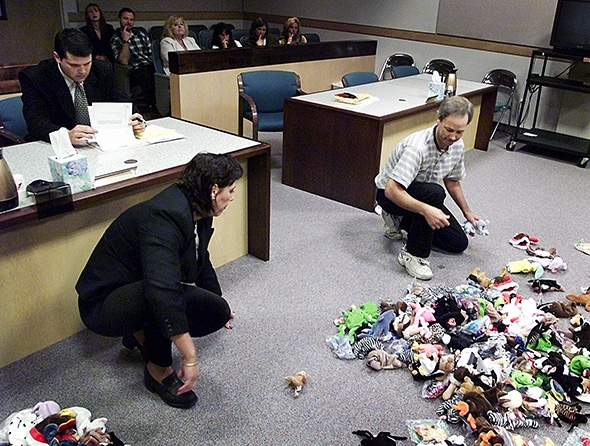
Frances
Mountain, left, sorts out Beanie Babies with her ex-husband, Harold
Mountain, in a Las Vegas courtroom in 1999. The couple was unable to
split the collection by themselves, so they spread it on the courtroom
floor and divided it up under the judge’s supervision. Maple the Bear
was the first to go.
Photo by Reuters
A paper
by David Tuckett and Richard Taffler, two economics professors with
training in psychoanalytical theory, suggests Bissonnette’s conjecture
isn’t that far off. Tuckett and Taffler specifically examine the dot-com
bubble, but their theory applies to all modern bubbles. According to
the economists, humans occasionally view exciting new creations as
“phantastic objects,” which overwhelm us and skew our sense of reason.
Our brains begin to tell us that by obtaining these “magical” objects,
we will achieve some profound level of satisfaction—something akin to
transcendence. The thrill of the chase then muffles our ability to
rationally evaluate the actual worth of the object, and others’
willingness to go along with our fantasy reinforces our suspension of
logic.
All this theorizing may sound like so much argle-bargle. But the meat
of Tuckett and Taffler’s thesis builds on a famous theory of bubbles by
renowned economist Charles Kindleberger. According to Kindleberger,
every bubble has four basic stages: a grand new development that shocks
the market; “euphoria” over that development; a sudden “boom” in sales
and speculation; and, eventually, panic when the bubble bursts. Tuckett
and Taffler approve of Kindleberger’s model, adding a
coda—“revulsion”—to describe the collective hangover society experiences
when it realizes it has invested in junk.
In the Kindleberger model (with the Tuckett/Taffler twist), Beanie
Babies are a kind of magical object whose plush perfection captured the
imagination of a small subset of early adopters. Soon Beanie Baby
collectors sprang up to spread the toy’s transcendent joy, and then
everybody needed each new Beanie Baby to complete his or her collection.
But Warner limited the number of each animal produced, leading both
buyers and sellers scrambling to purchase new releases and, in the
process, wildly overvaluing their worth. Eventually, the fantasy
faded—for most people, after all, Beanie Babies do not bring about
nirvana—and the bubble burst. Buyers lost interest, sellers struggled to
offload their surpluses, and the whole country felt rather gross about
fixating on stuffed animals.
Andrew Odlyzko, a mathematician and bubble expert, proposes a simpler theory explaining speculative panics in his study
on the British Railway Mania of the 1840s. Odlyzko credits Railway
Mania in part to a “collective hallucination,” an extreme form of groupthink
wherein a significant chunk of society feverishly buys into a shared
dream with no regard for the skeptics and naysayers. (Some scholars think Jesus’ resurrection might have been an acute instance of collective hallucination.)
The existence of groupthink has been confirmed in a rich assortment of studies,
and Odlyzko’s theory expands the idea to economic bubbles. Under his
analysis, the initial coterie of Beanie Baby collectors comprised an
in-group that shared the great secret of Beanie Babies’ worth. As more
people discovered the toy, they yearned to learn this secret and partake
in the impending financial success of the Beanie Babies market. Soon,
millions of Americans were gripped by the conviction that they had
discovered an easy path to personal wealth. And thanks to their
collective hallucination of Beanie Babies’ worth, none of these
collectors ever realized that the only thing driving the Beanie Babies
market was their own conviction that the toys were valuable.
These theories may explain the mass delusions that enabled a large
chunk of the country to believe that a $5 Beanie Baby could eventually
be worth thousands. What they never quite get at, however, is that
initial spark of fascination: how the ineffable appeal of Beanie Babies
turned them, and not one of a thousand other 1990s trends, into a
collective mania. That allure can probably never be quantified.
But those who once loved Beanie Babies may still remember it. I certainly do, because I remember when I got my very first Beanie Baby. I was 7 and had just woken up from adenoidectomy surgery to see a family friend through the anesthesia haze. She leaned over my bed and laid Bruno the Bull Terrier Dog by my head. I grabbed Bruno, closed my eyes as the room started spinning, and threw up. Bruno stayed with me through my convalescence, and long after I lost interest in Beanie Babies, he remained perched on my nightstand. There was something sweet and comforting and innocent about him, something so tender and gentle and warm. Bruno was the kind of toy Ty Warner was trying to make for children when he accidentally created a speculative mania for adults.
In 2013, Warner pleaded guilty
to tax evasion after admitting to hiding millions of dollars in a Swiss
bank account. He was sentenced to probation but may face years of
prison time if the Justice Department’s appeal is successful. Bruno the
Bull Terrier Dog now sits at the back of my closet with hundreds of
other floppy, forlorn toys. Today he sells for 36 cents, with the tag still attached.
Perseverance and hard work are often touted as the roads to success. But I remember once as a kid I hit a rough patch. It was a confusing time, and I reached out to someone who told me, "You're doing a lot of the right things, except perhaps the most important one; The way you look at things. Attitude is altitude, and altitude is consciousness."
Ten minutes. In reality, it was a matter of seconds but for Lance
Thomas, Gordon Hayward’s halfcourt attempt lingered in the air for an
eternity before the ball painstakingly made its way to the basket,
clanged off the rim and fell to the court.
The buzzer blared, signaling Duke University’s two-point victory in
the 2010 NCAA championship game over Butler University. Jon Scheyer
jumped on Thomas’ back in celebration, sending his co-captain to the
ground in a burst of chaos and excitement. Thomas hit his head on the
court.
“I opened my eyes and confetti was falling all over me,” Thomas said. “It was amazing.”
Five years later, Thomas remembers the vivid details of the moment
from his space in the New York Knicks’ visitors locker room at TD
Garden. He has played in just two more games in the NBA than he did
during his four-year career at Duke – a slower paced journey than he
expected, but one he has embraced.
Thomas knew when he lifted the trophy the night of April 5, 2010, it
did not guarantee him a spot in the pros. He returned to campus (with a
hero’s welcome) to complete the semester and graduate. As June neared
and NBA hopefuls prepped for the draft, Thomas did not expect to hear
his name called. He had averaged 4.8 points and 4.8 rebounds as a
senior, a ways away from strong consideration.
Thomas still believed he could play in the NBA, though. Instead of the draft, he viewed the D-League as his best route.
“I wasn’t really a guy who was on the radar like that,” Thomas told
Basketball Insiders. “I was a proven winner, but I wasn’t really putting
up NBA numbers to put myself in position to be drafted in the first
round or anything like that. My main thing was, I just wanted the
opportunity to show that I could be an NBA player. When I had the
opportunity to play in the Development League, I was like, this is a
no-brainer. I want to do that and try to prove it.”
Thomas was selected by the Austin Toros in the second round of the
2010 D-League draft. He was far from Cameron Indoor Stadium, but he
described the Toros fanbase as “very great.” He wasn’t there for the
hoopla anyways. Thomas credits the coaching staff for working
extensively with him on the skills he needed to take the next step and
making him feel like he had a chance to accomplish his goal.
“It’s competitive,” Thomas said of the D-League. “It’s like a bunch of crabs in a barrel. Everybody wants to get to the NBA.”
The following summer, he was named to the U.S. team for the 2011 Pan
American Games, a squad made up of D-League players during the lockout.
From there, he received a training camp invite from the then-New Orleans
Hornets. Thomas bounced around between the Toros and the Hornets before
earning an NBA deal for the remainder of the season after a pair of
10-day contracts.
“A lot of days are tough,” he said. “ There are days when you just
never know what’s going to happen – the trade deadline is coming up, the
last two days of your 10-day contract, things of that nature. I’ve
never been a guy to look over my shoulder. I just go for it. I never
wonder what if.”
Thomas appeared in 106 games for the now-Pelicans over three seasons,
averaging 3.0 points and 2.3 rebounds in 12.4 minutes. When the team
released him in November of 2013, he decided to pursue basketball in
China for the Foshan Dralions.
“Of course you always miss (the NBA),” he said.
He was determined to make it back. Last September, the Oklahoma City
Thunder signed Thomas. He averaged 5.1 points and 3.4 rebounds in 20.5
minutes over 22 games, including 13 starts, before being traded to the
New York Knicks in January as part of the Dion Waiters-Iman
Shumpert-J.R. Smith deal.
The changes weren’t done yet. The Knicks waived him two days later,
only to re-sign him on a pair of 10-day contracts. The New Jersey native
is now posting a career-high 9.3 points and 3.4 boards in 24.6 minutes
in his latest stop close to home.
Teammate Quincy Acy, who competed against Thomas in the Elite 8, has seen growth since their college years.
“He brings his hard hat to work every day,” Acy said. “He mostly
played the four in college and now he can guard the one through five.
That’s a testament to his hard work. (His journey) says a lot about him,
his perseverance and his will to get where he wants to go. Nobody can
tell him what he can’t do.”
Thomas understands success in the NBA is a process. He has never been
one to rush his progress and is willing to be patient, putting in the
work necessary to stick in the league. Knicks guard Shane Larkin noted
the extra time he spends at practice and describes his work ethic as
“100 percent pedal to the metal.”
“I never expected anything; I’ve never been like that,” Thomas said.
“I’ve always wanted to take the next guy’s head off if I’m competing
against him. I think that’s what’s fueled me to continue to play this
game. My competitive nature and drive has gotten me where I’m at.”
The memories of winning a national championship at Duke will always
be special to Thomas. The sound of the final buzzer and downpour of
confetti are still clear in his mind after journeys through the
D-League, NBA and overseas. He wants to be remembered as a person who
“worked his butt off, and on top of that he’s a winner.” If that means
paying his dues over the past five years, he’s all in.
“I really have no regrets with how my career has turned out,” Thomas
said. “It’s been unique, to say the least. Everything I’ve had or
accomplished in life has never been laid out on the red carpet for me. I
think all the things that have been thrown my way in regard to this
game makes my story that much better.”
If you're going to sin, sin against God, not the bureaucracy; God will forgive you but the bureaucracy won't.
--Hyman Rickover
Today, the poster child for "terror" is ISIS. But here's a fact: Assad killed and terrorized in excess of ISIS. So did Pol Pot, one of the most vile pieces of crap in history, but we didn't care to give the latter any attention at all, and Assad is alive and well, with nary a mention these days in the msm.
Next year marks a watershed: the richest 1% will own 50% of the wealth. (1) In my mind, it doesn't take much to see what's going on, but Graeme Wood, in a multi-thousand word screed in The Atlantic, has upped the ante: the real terror lies out there, and its face is brown, strapped and alien. To misunderstand ISIS as fundamentally Muslim is to miss the mark.
While talking with an old college buddy about the Wood article, we came to a conclusion, irrespective of Wood's take: while we'd want to kill ISIS if they moved into our hood, it isn't privileged kids beheading and pillaging. By and large, these kids of ISIS -- and Boko Haram, Al Shabob, Al Qaeda... -- are poor. The brothers, cousins or cronies of Bin Laden -- let's not forget, he was a billionaire -- don't pick up AKs or strap on C4 and blow themselves up. But then, neither do the sons of Congress.
And it's not a simple matter -- as a recent cartoon illustrated -- of providing jobs. Social order is a complex thing. This is why "revolution" is far more than just chopping off -- beheading -- Mussolini's dome and dragging it around. Take a look at one element of modern society, trash, the non-human kind, in a de-stabilized environment, whether seized or undergoing the ousting of a despot:
1. Who's going to pick up your trash, and who's going to manage that?
2. Where's the money come from?
3. How's that money raised?
4. Who's responsible for doling it out?
5. Who does the accounting?
6. Where's the infrastructure; trucks, fuel, repairs, truck parts, supplies, let alone human resources like drivers, mechanics....
7. And, the rub perhaps lies in, how are you going to feel when the trash has piled up after a couple of weeks? A couple of months? What if it starts to smell like a barn, 24/7?
Multiply this by many times to account for the myriad things cities have, and of course, this social organization opens the door for death by bureaucracy. It's a tough slog, but the reality.
To put this in perspective, the Dodd-Frank Bill is 2,300 pages. The Financial Crisis Inquiry Commission's report is 500 pages with 80 pages of notes. We're talking paper, TONS of it. The reality is that you and I know no one in their right mind is going to read either of those. And yet, both are related to the most monumental event of our time.
One more thing the bureaucrooks are great at: hoovering up your money. So much so that Cali now has more bureaucrooks than those in manufacturing.
Why Does Maryland Have The Most Millionaires Per Capita? The Answer Might Make You Angry
By Michael Snyder, on February 24th, 2015
The fat cats in Washington D.C. are living the high life, and they are doing it at your expense. Over the past decade, there has been one area of the country which has experienced a massive economic boom. Thanks to wildly out of control government spending, the Washington D.C. region is absolutely swimming in cash. In fact, at this point the state of Maryland has the most millionaires per capita in the entire nation and it isn’t even close. If you have never lived there, it is hard to describe what the D.C. area is like. Every weekday morning, hordes of lawyers, lobbyists and government bureaucrats descend upon D.C. from the surrounding suburbs. And at the end of the day, the process goes in reverse. Everyone is just trying to get their piece of the pie, and it is a pie that just keeps on growing as government salaries, government contracts and government giveaways just get larger and larger. Of course our founders never intended for this to happen. They wanted a very small and simple federal government. Sadly, today we have the most bloated central government in the history of the planet and it gets worse with each passing year.
If you were to ask most Americans, they would tell you that the wealthiest Americans probably live in cities such as New York or San Francisco. But thanks to the Obama administration (and before that the Bush and Clinton administrations), the state of Maryland is packed with millionaires. In particular, the Maryland suburbs immediately surrounding D.C. are absolutely overflowing with government fat cats that make a living at our expense. Every weekday morning, huge numbers of them leave their mini-mansions in places such as Potomac and Rockville and drive their luxury vehicles to work in the city. As the Washington Post has detailed, at this point approximately 8 percent of all households in the entire state of Maryland contain millionaires, and the rest of the area is not doing too shabby either…
In Maryland, nearly 8 out of every 100 households in 2014 had assets topping $1 million, giving the state more millionaires per capita than any other in the country, according to a new report from Phoenix Marketing International.
The rest of the Beltway isn’t lacking in millionaires either: The District and Virginia ranked in the top 10 among those with the highest number of millionaire households per capita in 2014. In Virginia, which was No. 6 on the list, 6.76 percent of the state’s 3.17 million households are millionaires. And in the District, which rounds out the top 10, 6.25 percent of its more than 292,000 households are millionaires.
And while not too many of them are millionaires, your average federal workers that toil in D.C. are doing quite well too.
Once upon a time, it was considered to be a “sacrifice” to go into “government service”.
Not anymore.
If you can believe it, approximately 17,000 federal employees made more than $200,000 last year.
Overall, compensation for federal employees comes to a grand total of close to half a trillion dollars every 12 months.
In fact, there are tens of thousands of federal employees that make more than the governors of their own states do.
Does that seem right to you?
If you want to live “the American Dream” these days, the Washington area is the place to go. Just check out the following description of the region from the Washington Post…
Washingtonians now enjoy the highest median household income of any metropolitan area in the country, and five of the top 10 jurisdictions in America — Loudoun, Howard and Fairfax counties, and Falls Church and Fairfax City — are here, census data shows.
The signs of that wealth are on display all over, from the string of luxury boutiques such as Gucci and Tory Burch opening at Tysons Galleria to the $15 cocktails served over artisanal ice at the W Hotel in the District to the ever-larger houses rising off River Road in Potomac.
And of course let us not forget the fat cats in Congress.
According to CNN, our Congress critters are now wealthier than every before…
The typical American family is still struggling to recover from the Great Recession, but Congress is getting wealthier every year.
The median net worth of lawmakers was just over $1 million in 2013, or 18 times the wealth of the typical American household, according to new research released Monday by the Center for Responsive Politics.
And while Americans’ median wealth is down 43% since 2007, Congress members’ net worth has jumped 28%.
Nearly 200 are multimillionaires. One hundred are worth more than $5 million; the top-10 deal in nine digits. The annual congressional salary alone—$174,000 a year—qualifies every member as the top 6 percent of earners. None of them are close to experiencing the poverty-reduction programs—affordable housing, food assistance, Medicaid—that they help control. Though some came from poverty, a recent analysis by Nicholas Carnes, in his book White Collar Government: The Hidden Role of Class in Economic Policymaking, found that only 13 out of 783 members of Congress from 1999 to 2008 came from a “blue-collar” upbringing.
Incredible.
But even though almost all of them are quite wealthy, they don’t hesitate to spend massive amounts of taxpayer money on their own personal needs.
For example, according to the Weekly Standard, more than five million dollars was spent on the hair care needs of U.S. Senators alone over one recent 15 year period…
Senate Hair Care Services has cost taxpayers about $5.25 million over 15 years. They foot the bill of more than $40,000 for the shoeshine attendant last fiscal year. Six barbers took in more than $40,000 each, including nearly $80,000 for the head barber.
And in one recent year, an average of $4,005,900 was spent on “personal” and “office” expenses per U.S. Senator.
So the grand total would have been over 400 million dollars for a single year.
That seems excessive, doesn’t it?
And even when they end up leaving Washington, our Congress critters have ensured that they will continue to collect money from U.S. taxpayers for the rest of their lives…
In 2011, 280 former lawmakers who retired under a former government pension system received average annual pensions of $70,620, according to a Congressional Research Service report. They averaged around 20 years of service. At the same time, another 215 retirees (elected in 1984 or later with an average of 15 years of service) received average annual checks of roughly $40,000 a year.
If you can believe it, there are quite a few former lawmakers that are collecting federal pensions for life worth at least $100,000 annually. The list includes Newt Gingrich, Bob Dole, Trent Lott, Dick Gephardt and Dick Cheney.
Of course the biggest windfalls of all are for our ex-presidents. Most Americans would be shocked to learn that the U.S. government is spending approximately 3.6 million dollars a year to support the lavish lifestyles of former presidents such as George W. Bush and Bill Clinton.
============================
1. Richest
1 Percent To Own More Than Half Of The World's Wealth By 2016, Oxfam
Finds www.huffingtonpost.com/2015/01/19/world-wealth-oxfam_n_6499798.html
Hank told me that an analyst by the name of Richard Vague was on Book TV talking about EM08, specifically, on re-structuring the debt so that the economy could get back to spending instead of tightening its belt. I don't know how long C-Span leaves this up, but Here's the link.
While what Vague proposes is much more sensible than the insanity of the Bush2/Obama admins and Bernanke/Yellen Feds, the essential problem is this: it's socialist and utterly, completely unfair. Particularly with what we now know about the massive fraud and non-disclosure (in particular, ninja loans, robo-signing and not disclosing the real state of toxicity on behalf of Merril when then BoA Chair/Pres.CEO Ken Lewis and Merril CEO John Thain held their dog and pony press con announcing the takeover of Merril by BoA which subsequently and justifiably -- led to shareholder litigation).
(I do think his theory of meltdowns being the result of non-governmental debt -- a better way, methinks, of describing it, rather than constantly differentiating and synthesizing between "private and business" -- is interesting and makes sense. I'm going to sit with it a while.)
A much saner and fairer strategy is converting debt to equity. In other words, the bondholders have to take a loss (at least temporarily) or, in the popular parlance, take a haircut. I remembered hearing this the first time from Pershing Square's Bill Ackman on the Charlie Rose Show from April 24, 2009.
Bonds, like equities, are bets. And sometimes, you lose a bet. Plain and simple. But listen to these segments and you'll hear them all concur that the bondholders would rather take money from us to cover their losses. Duh. That frickin' Bill Gross plus Mohammed El-Arian probably got on the horn to Bush 2 and Bernanke as well.
Yet, it is kind of amazing to hear this level of frankness on the Charlie Rose Show. I think that worthless Sorkin is the one who calls out Gross. So maybe he's a little less worthless.
The other notable thing is the ersatz nattering by Sorkin and Kate Kelly, the former the NYT's econ wunderkind -- don't ask me why -- and the hopelessly lost (irrelevant? afterthought?) Kate Kelly of the WSJ. Watch her as the director cuts to her as Ackman schools the audience on why debt to equity makes sense. She looks like a freshman witnessing Wittgenstein.
THIS -- Ackman's lesson -- was THE way to have handled EM08. Not socialism, which both parties have their hands in. By the way, I'm attributing this strategy to Ackman but am aware this is just a bankruptcy re-structuring. Makes sense to me.
Note: I couldn't find the entire segment, but these two parts have Ackman kicking ass. The difference in gravitas between him and the others -- and that includes Nobel Laureate Stiglitz -- is remarkable. Now notice: Sorkin and Kelly? Journalists. Stiglitz? Academician. Ackman? Entrepreneur.
Nothing wrong with the other professions, but after listening to these clips, who do you think has a grip?
He can be controversial, as his recent bouts with Herbalife attest to, but in mere months after the fall of 2008, Ackman had the way out.
Since
the Wileys lived 2,000 miles away, we rarely saw one another, but the
news of Auntie's passing of course still hurts us all out here in
Cali. So, I told my cousin Kim that while I wanted to memorialize her
mom, it then hit me; with such limited interaction, what would I say?
I'd pretty much committed my Wiley recollections when writing about
her son, cousin Joey.
Given
that my approach would have to be wide-angled, where's the hook?
More, is such an approach worthy? In the end, ascribing thoughts and
feelings to someone you've affection for and have very limited
interaction with is tough.
But
this is Ma's sister.
The
ego pushes on, but honestly, because I feel so strongly about the
Yoshidas, and in this moment, my mother's sister, that generation and
their time.
So
here's to some reaching, some talking about Auntie via indirect
lenses. After quite a bit of pondering, I think the heart of it is
this American story whose great chapter is coming to a close. Like
Ma's passing, the Yoshidas – the Nisei -- mark a unique time in
American history, where rising from the depths through a get it done
attitude into cool, fresh air was done en masse. I, and all of my
cousins, are the fruits, the living embodiment of an America that
was. Not earth shattering, but it's our story.
The
saying is, you can't choose your family, but the Yoshidas are lucky; we come from solid stock.
The family huddles don't happen anymore, so, yes, here's to
nostalgia. Really, it isn't so much about nostalgia, but reverence. I
can see how that sounds corny, but I'm long past the point where what
the Yoshidas slogged through impressed me. Romantic, yes, and not
wide-eyed, but a bit misty-eyed.
There's
all of that and the practicality of speaking from the heart about a
woman I barely knew but am bound to through blood and affection. My
mother's sister.
Auntie
said something the last time I saw her in Chi: I'd kill for my
kids, and it's something that's always stuck. While the context is
lost, the intensity isn't; she meant it with every fiber. I'm
agnostic when it comes to astrology, but it does seem that the nature
of us Cancers is to feel intensely; you see, here's something Auntie
and I share besides blood: we have the same birthday.
Having
read Auntie's bio forwarded by Kim made me smile: intellectual
prowess, artistic bent and a touch of precociousness – chutzpah,
maybe...? – stood her out among 7 brothers and sisters.
Auntie on the left bent over leaning on May, Ma on the ground. The BEST.
Her siblings shared that penchant for cracking up duly noted when writing about Ma. Seems whenever the Yoshida sisters got together something would set them off, and Auntie Frances, Auntie May and Ma seemed to always be removing their glasses at some point, crying tears of laughter. Since I was an only kid, the Wileys or any family that rolled through LA, would
May, Frances, Ross, Ma, Kathy. Auntie's already got the bug!
invariably stay with us, so ringside seats seeing these scenes play out are enduring memories. Luck's given us Yoshida cousins a great family – and stories -- separated by geography but united by such a great spirit.
When
the Wiley brood rolled through LA back in the day the cousins stayed
with us, and I went from an only child to swimming in cousins.
There's a couple of good stories in there. Here's one; Ma and Auntie
had us boys in the bathroom prepping us for a bath. So, I stripped
down to the tighty whiteys and then stood up straight. Auntie, a
shock of hair across her face, was bent over, going through the task
that for her was by now routine, busily pulling up Larry's or Jimi's
– or both! -- t-shirt over his head. I think Joey was already butt
naked.
Auntie:
C'mon Geoffrey!
Me:
Uh....
Auntie:
(not missing a beat) Oh! You haven't got anything I haven't seen, and
if you do, show me!
Amidst
her intellect and artistic leanings, I think that straightforward
pragmatism is something her generation had, but in many ways, is lost
today. Yeah, life's uncomfortable at times and can be tough. Shut
up and play yer guitar!
America
recently crossed a milestone: More of us now live in cities than
rural areas. Coming up in Lindsay, the Yoshidas were country as all
get out, and so it was with Auntie developing her dislike of chicken
from plucking them. There's much more, of course, even in the face of
my romanticizing the Brokaw dubbed 'Greatest Generation.” Bottom
line, I'd bet that not one of the 25 Yoshida cousins has ever plucked
a chicken (at least willingly), much less experienced a day of
hunger.
Despite
the betrayal of her country to her family, Auntie Frances got on with
it. She couldn't have been happy about the prison camps (let's call
them what they were), but her drive to excel was evident; her
masters from Chicago and especially her 8 kids, the ones she'd kill
for. And a gaggle of grandkids.
It's
funny how getting older brings the essentials into focus, nearer, and
yet still beyond reach. Why are we here? Auntie Frances and her
generation didn't beseech the heavens from rooftops, nor did they
indulge in selfies much less in “finding themselves,” but just
got on with business. “No monku-ing” was their motto. They are
the last of an America that needs some of that old school grit now.
We
watched Michael Jordan perform jaw-dropping feats, but hidden away are the endless days and nights of practice. The Malcolm Gladwell codified "10,000 hours" minimum practice it takes to become good at something.
I
hated every minute of training, but I said, 'Don't quit. Suffer now
and live the rest of your life as a champion.
--Muhammad
Ali
So,
there's the finished product that was Auntie Frances, a drive to
excel and the bevy of good people she produced and helped. It's not the spotlight or in the championship ring. It's pulling off my cousin's t-shirt as a little kid to get ready for a bath. It's being mad at Joey and trying to whup his butt but giving up and flopping in a chair because he was making her laugh so much. A shock of hair and
the Yoshida love of laughter.
No, it's not the bright lights, it's answering life with getting down to it. Being a country girl from Lindsay, what's hidden
is the practice, those plucked chickens.
We weren't really surfers in the traditional sense you know? We're from VENICE. --Skip Engblom
[Jay's] the original. --Shogo Kubo
[Jay's] the real thing, an original seed, the original virus that infected all of us. He was beyond comparison. --Stacy Peralta It's fitting that R.I.P. is "rip," because that's what this LA legend did.
It's all about getting information...they call it trading stocks, but it's really trading information. That's what we were doing.
--Turney Duff, former Galleon trader
Just peeped Scorsese's The Wolf of Wall Street, and I'd bet the average person would say it's about the craziest story ever. I'd get that. But Jordan Belfort's slimey infomercial rat-a-tat buggery is chump change compared to the middle-class soul sucking black hole that's the state of finance now.
Yesterday, Frontline aired To Catch a Trader, whose bullseye was puss sack Stevie Cohen (SAC Capital). Given that I've devoted a good amount of time to looking at finance now, not much these days surprises me. One thing did; "expert networks," camouflage for leakers on the inside who personally profit by leaking info (in advance, of course) to traders.
Turney Duff related how he picked up a call intended for Rajaratnam with a tip on Amazon. Raj wasn't around, so Duff took the call and the info. It being his first experience with insider rigging, he hung up and wondered what he should do.
He ended up placing a bet and "making" 500 g's in 30 minutes. But it's what Duff says after this that's key, and I paraphrase: "I thought, 'Gee, if I could get a call like this every day, I could be a great trader too.' So I determined that I needed my own 'whisper guy' too." Poker players don't cheat. In fact, gamblers are, at least when it comes to gambling, some of the most ethical and honest people I've ever encountered. But in this EM08 world where up is down, gangster dons like JPMC, Goldman and HSBC get away with historic looting, while nothing is done to police them -- even in the wake of their historic crimes! Meanwhile, walk into a Vegas casino and you'll have a camera up your ass and are surveilled at every turn.
One of the most important skills is reading, not literacy-wise, but assessing information in order to make decisions, to act. Athletes, coaches, entrepreneurs, politicians, school counselors, shrinks, investors, parents... all of us in one way or another make decisions based upon reads of situations.
Here's back to back world poker champion Johnny Chan making one of the most incredible lay downs ever. For those non-poker players, a lay down is when you fold, or quit your hand, and here Chan is dealt pocket aces, the optimum starting hand in poker's "cadillac of games, Texas Hold 'Em (dubbed by two-time world champ, Doyle Brunson in his seminal book on poker, "Super System," who's in the cowboy hat).
Chan's read of the situation is spot on, but what's interesting is his assessment afterwards, that "instinct" just told him and he concluded that his aces were no good. As commentator Ali Nejad aptly says, it's poker at the highest level, true, but what's interesting here is that Chan gives credit to his instinct, his gut.
Now up the ante to human destruction, and that's light years beyond poker. That was the "poker table" Stanislav Petrov was at. And it's interesting that like Johnny Chan, something in his gut told Petrov things weren't right.
I first heard the story of Stanislav Petrov via Glynn Washington's show, Snap Judgement. I recommend listening; it's the segment "End of Days." Kudos.
Too many stories in history are relegated to obscurity. Here's one that deserves sunlight, devoid of negotiations between the White House and the Kremlin, but nonetheless shows history playing out at its own highest level and the greatest read ever.
Petrov receives a 2011 German media award from Karlheinz Koegel, chief of the German Media Research Group, during a ceremony in 2012. (Reuters)
It was September 26, 1983. Stanislav Petrov, a lieutenant colonel in the Soviet Air Defence Forces, was on duty at Serpukhov-15, a secret bunker outside Moscow. His job: to monitorOko, the Soviet Union's early-warning system for nuclear attack. And then to pass along any alerts to his superiors. It was just after midnight when the alarm bells began sounding. One of the system's satellites had detected that the United States had launched five ballistic missiles. And they were heading toward the USSR. Electronic maps flashed; bells screamed; reports streamed in. A back-lit red screen flashed the word 'LAUNCH.'"
That the U.S. would be lobbing missiles toward its Soviet counterpart would not, of course, have been out of the question at that particular point in human history. Three weeks earlier, Russians had shot down a South Korean airliner that had wandered into Soviet air space. NATO had responded with a show of military exercises. The Cold War, even in the early '80s, continued apace; the threat of nuclear engagement still hovered over the stretch of land and sea that fell between Washington and Moscow.
Petrov, however, had a hunch -- "a funny feeling in my gut," he would later recall -- that the alarm ringing through the bunker was a false one. It was an intuition that was based on common sense: The alarm indicated that only five missiles were headed toward the USSR. Had the U.S. actually been launching a nuclear attack, however, Petrov figured, it would be extensive -- much more, certainly, than five. Soviet ground radar, meanwhile, had failed to pick up corroborative evidence of incoming missiles -- even after several minutes had elapsed. The larger matter, however, was that Petrov didn't fully trust the accuracy of the Soviet technology when it came to bomb-detection. He would later describe the alert system as "raw."
But what would you do? You're alone in a bunker, and alarms are screaming, and lights are flashing, and you have your training, and you have your intuition, and you have two choices: follow protocol or trust your gut. Either way, the world is counting on you to make the right call.
Petrov trusted himself. He reported the satellite's detection to his superiors -- but, crucially, as a false alarm. And then, as Wired puts it, "he hoped to hell he was right."
He was, of course. The U.S. had not attacked the Soviets. It was a false alarm. One that, had it not been treated as such, may have prompted a retaliatory nuclear attack on the U.S. and its NATO allies. Which would have then prompted … well, you can guess what it would have prompted.
As Petrov, now retired and living in a town near Moscow, puts it of his decision: "That was my job. But they were lucky it was me on shift that night."
Thirty years later, there are lingering questions about the specific events of September 26, 1983. Was it really up to Petrov, the single man, to make the call? Weren't there other failsafes that would allow for malfunctioning technology? Wouldn't other cool heads, finally, have prevailed? Petrov, for his part, emphasizes the ambiguity of the situation, saying after the incident that he was never convinced the alarm was erroneous. (The odds of his getting it right, he now figures, were pretty much 50-50.)
One thing that seems clear, however, is that the world carried on into September 27, 1983 in some part because Stanislav Petrov decided to trust himself over malfunctioning machines. And that may have made, in a very broad and cosmic sense, all the difference. Petrov's colleagues were professional soldiers with purely military training; they would, being trained to follow instructions at all costs, likely have reported a missile strike had they been on shift at the time. Petrov, on the other hand, trusted his own intelligence, his own instincts, his own gut. He made the brave decision to do nothing.
Members of the Pensacola community have pressed the City Council to reconsider a so-called“camping” ordinance passed last summer, particularly the sections of the law that criminalize keeping warm with a blanket, tent or other materials commonly used by the homeless for shelter. At the time of its passage, the ordinance was defended in the Council on the bases that “camping” in public was considered a threat to sanitation, public health, and safety, in addition to being a blight on Pensacola’s “aesthetic” quality.(1)
See, Lloyd, we're more than leaders. We're fine, upstanding models of American citizenship. Cleave to that, baby boy. L'chaim.
What does "the law of unintended consequences" tell us? Careful what you wish for... For every action... You may get what you pay for, but you pay for everything you get....
Time worn sayings all, leading us down the same road. In the case of EM08, take a look around and notice, not just what's illegal, but what gets indicted, what gets prosecuted. In other words, what has a target on it?
It's easy enough to see that the evil empire dons are above the law, but when we criminalize the homeless, folks, we're nearing the bottom. Even for EM08.

 Mark Joseph Stern is a writer for Slate. He covers science, the law, and LGBTQ issues



 By Michael Snyder, on February 24th, 2015


